Amazon MQ vs CloudAMQP vs Alternatives: Best RabbitMQ Hosting 2026
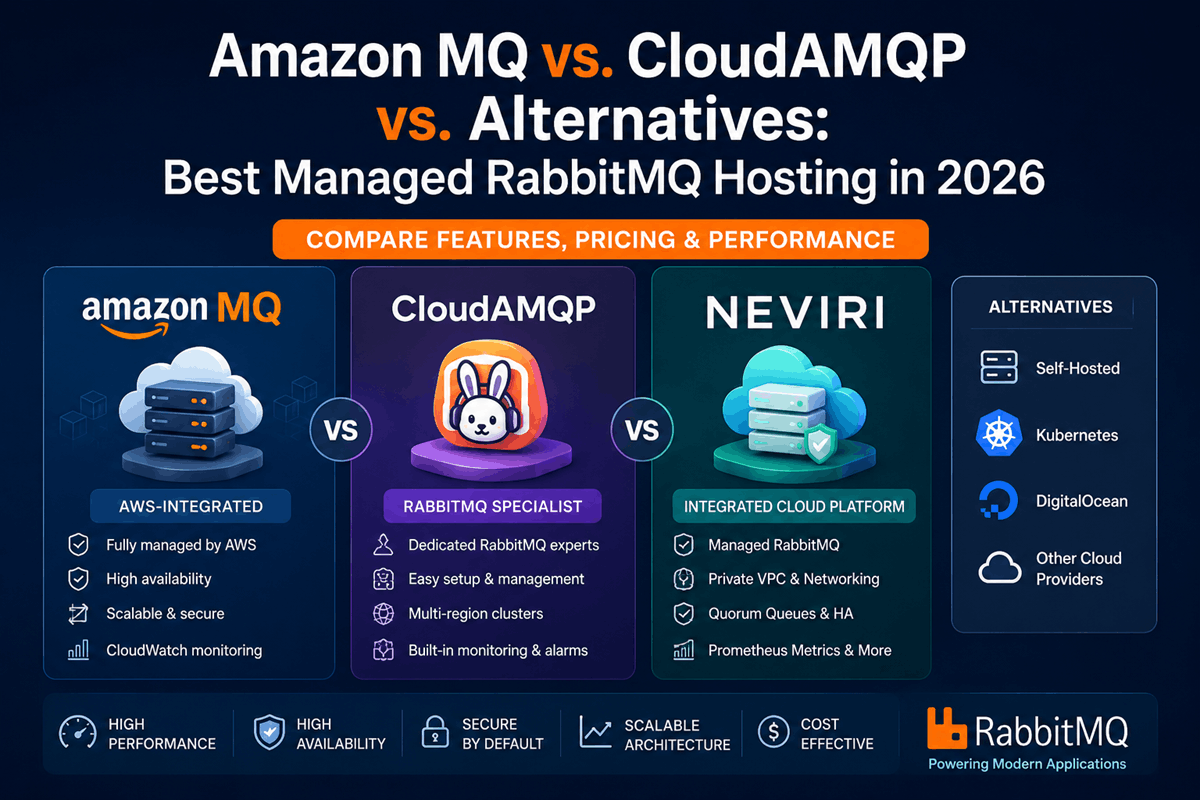
RabbitMQ powers messaging across distributed applications, microservices, background jobs, and asynchronous workloads. Installing it on a server takes minutes. Running it in production is a different job.
In production you own clustering, quorum queues, persistence, upgrades, monitoring, failover, backups, security, and recovery.
That operational load is why teams move to managed RabbitMQ hosting.
By 2026 the question isn't how to host RabbitMQ. It's which managed provider gives your team the best mix of reliability, features, pricing, and operational simplicity.
The main options are Amazon MQ, CloudAMQP, Neviri Managed RabbitMQ, enterprise RabbitMQ offerings, and self-hosted deployments on cloud infrastructure.
Quick Answer
Amazon MQ fits organizations already invested in AWS that need RabbitMQ inside AWS networking and security.
CloudAMQP is a RabbitMQ-as-a-service specialist. It offers shared and dedicated plans, multi-node clusters, monitoring, alarms, plugins, and several networking options. Plans start free for development, $19/month for a shared hobby plan, and $50/month for a dedicated single-node plan.
Neviri Managed RabbitMQ suits teams that want RabbitMQ beside the rest of their stack: compute, VPC networking, managed databases, storage, and monitoring. It ships quorum queues, dead-letter routing, Prometheus metrics, TLS, and private VPC deployment.
Self-hosted RabbitMQ gives you the most control and hands your team cluster management, upgrades, monitoring, security, and recovery.
For most startups, pick the provider that removes the most operational work at a reasonable total cost. Feature count matters less.
Managed RabbitMQ Providers Compared
| Provider | Best For | Starting Point | Main Strength |
|---|---|---|---|
| Amazon MQ | AWS-centric organizations | Usage-based | AWS integration |
| CloudAMQP | RabbitMQ specialists | Free / $19 shared | RabbitMQ expertise |
| Neviri | Startups and integrated infrastructure | Contact/current pricing | RabbitMQ + integrated cloud platform |
| Self-hosted | Maximum control | Infrastructure cost | Flexibility |
| Enterprise RabbitMQ | Mission-critical enterprise workloads | Custom | Enterprise support |
Pricing and capabilities change often, so validate any production decision against each provider's current pricing and documentation.
Amazon MQ
Amazon MQ is AWS's managed message broker for Apache ActiveMQ Classic and RabbitMQ.
It provisions brokers, runs maintenance, and applies version upgrades, and it integrates with AWS services such as CloudWatch and VPC networking.
For RabbitMQ, Amazon MQ currently supports RabbitMQ 4.2 on the m7g instance family and RabbitMQ 3.13 on supported instance families. AWS recommends RabbitMQ 4.2 for new deployments.
Amazon MQ strengths
- Deep AWS integration
- VPC integration
- CloudWatch monitoring
- Managed maintenance
- Encryption
- AWS IAM integration
- Single-instance and multi-node deployment models
- Managed RabbitMQ upgrades
Amazon MQ kept adding RabbitMQ capabilities through 2026, including private networking, Prometheus metrics, and in-place upgrades from RabbitMQ 3.13 to 4.2.
Amazon MQ weaknesses
The main drawback is AWS complexity, not RabbitMQ itself.
A RabbitMQ deployment can become one line item in a larger AWS bill that also covers:
- broker instances
- storage
- networking
- data transfer
- VPC components
- monitoring
- other AWS services
Amazon MQ pricing is usage-based. AWS charges for broker instance usage, storage, and applicable data transfer. A three-node cluster means paying for three broker instances, so costs add up.
AWS's own pricing example puts a three-node mq.m5.large RabbitMQ cluster in US East at about $642.82/month for broker instances, before the example's $60 storage charge.
Amazon MQ isn't expensive for every workload, but you should price the full architecture rather than the broker alone.
CloudAMQP
CloudAMQP takes a specialist approach. Instead of running a general-purpose cloud, it concentrates on managed messaging.
Its RabbitMQ lineup has shared and dedicated plans. The pricing page lists a free Little Lemur shared plan, a $19/month Tough Tiger shared plan, and dedicated plans from $50/month for a single-node Sassy Squirrel.
CloudAMQP also offers multi-node configurations. Its three-node clusters spread across availability zones where supported, and quorum queues handle RabbitMQ replication.
CloudAMQP strengths
- RabbitMQ specialization
- Simple provisioning
- Shared development plans
- Dedicated production plans
- Multi-AZ clusters
- Monitoring
- Alarms
- RabbitMQ management UI
- Plugin support
- VPC connectivity
- Multiple cloud regions
CloudAMQP lists regions across AWS and other clouds, including Mumbai, Hyderabad, Singapore, Sydney, Frankfurt, London, and several US regions.
It supports AMQP, AMQPS, HTTPS, STOMP, and MQTT.
CloudAMQP weaknesses
You're buying a specialist messaging service, not a full application infrastructure platform.
If your architecture needs:
- application compute
- RabbitMQ
- PostgreSQL
- Redis
- object storage
- load balancing
- private networking
you may end up stitching together several providers. That works, but it grows the number of platforms your team maintains.
Neviri Managed RabbitMQ
Neviri approaches RabbitMQ differently. RabbitMQ sits inside a larger platform that also includes VMs, VPC networking, load balancers, storage, and managed databases.
Neviri's current managed RabbitMQ product includes:
- quorum queues
- Raft-based replication
- dead-letter exchanges
- publisher confirms
- consumer acknowledgements
- AMQP
- MQTT
- STOMP
- TLS
- private VPC isolation
- RabbitMQ management UI
- Prometheus metrics
Neviri wires RabbitMQ into its compute and networking products, so queue depth can drive application scaling.
Why this matters
Picture a SaaS architecture:
Users
  ↓
Load Balancer
  ↓
API Servers
  ↓
RabbitMQ
  ↓
Worker Servers
  ↓
PostgreSQL
When these resources share one cloud environment, networking and infrastructure management get simpler. That is the strategic advantage of an integrated platform.
Neviri also offers managed PostgreSQL, MySQL, MongoDB, MariaDB, and Redis alongside RabbitMQ.
Where Neviri fits
- startups
- SaaS companies
- microservice architectures
- background workers
- Celery workloads
- asynchronous APIs
- event-driven applications
- teams that don't want to operate RabbitMQ clusters themselves
Amazon MQ vs CloudAMQP vs Neviri
| Factor | Amazon MQ | CloudAMQP | Neviri |
|---|---|---|---|
| RabbitMQ specialization | Good | Excellent | Strong |
| AWS integration | Excellent | Good | Varies |
| Managed RabbitMQ | Yes | Yes | Yes |
| Shared development plans | Limited comparison | Yes | Current product/pricing should be checked |
| Dedicated clusters | Yes | Yes | Yes |
| Multi-node HA | Yes | Yes | Yes |
| Private networking | Yes | Yes | Yes |
| Monitoring | CloudWatch | Built-in tools | Management UI + Prometheus |
| RabbitMQ 4.x | 4.2 | 4.3 available | Check current supported version |
| Broader cloud infrastructure | Excellent | Limited | Integrated |
| Best for AWS-centric teams | Excellent | Good | Depends on architecture |
| Best for RabbitMQ specialists | Good | Excellent | Strong |
| Best for integrated startup infrastructure | Good | Moderate | Strong |
These aren't identical products. Amazon MQ is an AWS managed service, CloudAMQP is a RabbitMQ specialist, and Neviri folds RabbitMQ into a broader managed infrastructure stack.
Amazon MQ Pricing
Amazon MQ uses usage-based pricing. AWS charges for:
- broker instance runtime
- storage
- applicable data transfer
- networking-related charges in certain configurations
RabbitMQ brokers use EBS storage, and pricing shifts with instance type, deployment mode, and region.
A real comparison doesn't stop at $X/hour versus $Y/month. Add up the full architecture:
AWS's own example shows why: a three-node mq.m5.large RabbitMQ cluster in US East runs about $642.82/month for broker instances, plus $60 of storage.
CloudAMQP Pricing
CloudAMQP's pricing is easier to read. Current RabbitMQ plans:
- Little Lemur: free shared RabbitMQ
- Tough Tiger: $19/month shared RabbitMQ
- Sassy Squirrel: $50/month dedicated single node
- Big Bunny: $99/month dedicated single node
- Happy Hare: $199/month
- Roaring Rabbit: $299/month
- larger plans for higher throughput
CloudAMQP also offers three- and five-node configurations on several production tiers.
That makes it a strong pick when you want a dedicated RabbitMQ service without building the surrounding infrastructure yourself.
What Is the Cheapest Managed RabbitMQ?
It depends on what "managed" means to you.
For development and hobby work, CloudAMQP has a free shared RabbitMQ plan, and its next shared tier is $19/month.
For production, headline prices mislead. A $50 single-node broker and a $300 three-node cluster aren't the same product.
When you compare production RabbitMQ hosting, weigh:
- node count
- replication
- storage
- throughput
- connections
- backups
- failover
- monitoring
- networking
- support
- data transfer
The cheapest broker rarely produces the cheapest production architecture.
Which Is Best for Startups?
For a startup, the decision usually turns on operational simplicity.
Choose Amazon MQ if:
Your infrastructure already runs on AWS and you want RabbitMQ inside your existing AWS environment.
Choose CloudAMQP if:
RabbitMQ is the main managed service you need and you want a specialist with straightforward RabbitMQ tooling.
Choose Neviri if:
You want RabbitMQ next to your application servers, databases, networking, and other infrastructure on one cloud platform.
For a typical SaaS startup, that last point carries weight. The infrastructure might look like:
Neviri Load Balancer
        ↓
Neviri VMs
        ↓
Neviri RabbitMQ
        ↓
Neviri Workers
        ↓
Neviri PostgreSQL
instead of operating each component across different platforms.
Managed RabbitMQ vs Self-Hosted RabbitMQ
Self-hosting RabbitMQ can look cheaper. You can deploy it on:
- AWS EC2
- Neviri VMs
- DigitalOcean
- Hetzner
- Kubernetes
- bare metal
Infrastructure cost is only part of the bill. You also own:
- RabbitMQ upgrades
- OS patching
- cluster configuration
- backups
- monitoring
- alerts
- disk management
- security
- failover
- recovery
- capacity planning
RabbitMQ is free and open source, but production operations aren't. RabbitMQ runs across cloud infrastructure, VMs, and containers by design, and commercial offerings add enterprise support and capabilities.
Self-hosting pays off when your team has the expertise and the workload justifies the extra operational responsibility.
What About RabbitMQ 4.3 in 2026?
Version support matters here.
RabbitMQ 4.3 shipped in April 2026 with quorum queue compaction, delayed retries, consumer timeout changes, and further AMQP 1.0 improvements.
CloudAMQP announced RabbitMQ 4.3 availability on August 27, 2026.
Amazon MQ currently supports RabbitMQ 4.2 in its RabbitMQ 4 series.
If you specifically need RabbitMQ 4.3, confirm supported versions before you pick a managed provider. Generic comparison articles tend to skip this detail.
Which RabbitMQ Provider Should You Choose?
Choose Amazon MQ when:
- Your infrastructure is already on AWS
- You need deep AWS integration
- You use AWS VPC extensively
- CloudWatch is your monitoring standard
- Your team already understands AWS
- You want AWS-native managed infrastructure
Choose CloudAMQP when:
- RabbitMQ is your primary requirement
- You want specialist RabbitMQ expertise
- You need multiple RabbitMQ plans
- You want dedicated RabbitMQ clusters
- You want straightforward RabbitMQ management
- You need broad cloud-region availability
Choose Neviri when:
- You want RabbitMQ integrated with application compute
- You need managed databases alongside RabbitMQ
- You want private VPC infrastructure
- You want one cloud dashboard
- You're building a startup or SaaS platform
- You want managed RabbitMQ without building the cluster yourself
Choose self-hosted RabbitMQ when:
- You have strong infrastructure expertise
- You need maximum configuration control
- You can operate RabbitMQ 24/7
- You have established monitoring and backup systems
- Infrastructure savings justify the operational burden
Expert Insight
The biggest mistake when selecting RabbitMQ infrastructure is comparing broker prices instead of total operational cost.
A broker might run $50, $100, or $300 a month. The real cost includes more:
For a startup with two engineers, a few hours of RabbitMQ maintenance each month can cost more than the infrastructure. That shifts the decision.
So don't aim for the cheapest RabbitMQ server. Aim for the cheapest reliable RabbitMQ architecture your team doesn't have to constantly operate.
One more 2026 shift: RabbitMQ keeps growing past its "message queue" label. RabbitMQ 4.3 improves quorum queues and messaging, and the official project increasingly positions RabbitMQ as both a messaging and streaming broker.
That makes version support, observability, and operational maturity bigger factors when you choose a managed provider.
Frequently Asked Questions
1. Is Amazon MQ good for RabbitMQ?
Yes. Amazon MQ provides managed RabbitMQ with AWS integration, maintenance, monitoring, and networking.
2. Is CloudAMQP better than Amazon MQ?
It depends. CloudAMQP specializes in RabbitMQ, while Amazon MQ wins for teams already using AWS extensively.
3. What is the cheapest RabbitMQ hosting?
Neviri offers a dedicated RabbitMQ plan alongside its cloud platform. Check current pricing before deploying.
4. What is the best RabbitMQ hosting for startups?
For startups, prioritize operational simplicity, predictable pricing, HA, and integration with your application infrastructure over raw broker price.
5. Can I run RabbitMQ on AWS?
Yes. Use Amazon MQ or self-host RabbitMQ on AWS infrastructure.
6. Can I run RabbitMQ on a VM?
Yes. RabbitMQ runs on cloud VMs, containers, and other supported platforms.
7. Is RabbitMQ free?
RabbitMQ's open-source edition is free under the Mozilla Public License 2.0.
8. Is managed RabbitMQ worth it?
For teams without dedicated messaging expertise, yes. It reduces the work around maintenance, monitoring, upgrades, and availability.
9. Does Amazon MQ support RabbitMQ 4.3?
Amazon MQ's RabbitMQ 4 series supports RabbitMQ 4.2 in current AWS documentation. If you need 4.3, confirm AWS support before deploying.
10. Does CloudAMQP support RabbitMQ 4.3?
Yes. CloudAMQP announced RabbitMQ 4.3 availability on August 27, 2026.
11. What is better for RabbitMQ: Kubernetes or managed hosting?
Managed hosting is usually simpler. Kubernetes fits when RabbitMQ is already part of an established Kubernetes platform and your team has the operational expertise.
12. Is RabbitMQ better than Kafka?
Neither wins universally. RabbitMQ is strong for messaging, routing, and work queues, while Kafka suits high-volume event streaming and durable event-log workloads.
13. What is a quorum queue?
A replicated RabbitMQ queue built for data safety and high availability using a consensus-based replication model.
14. Should RabbitMQ be in a private network?
For production workloads, keep the broker private when it doesn't need public exposure.
15. How do I choose a managed RabbitMQ provider?
Compare pricing, HA architecture, RabbitMQ versions, storage, backups, monitoring, networking, support, throughput, connection limits, and total operational cost.
Final Verdict
No single managed RabbitMQ provider wins every workload.
Amazon MQ is the natural pick for AWS-centric architectures. CloudAMQP is among the strongest specialist RabbitMQ-as-a-service options. Neviri fits when RabbitMQ needs to sit inside a broader managed environment with compute, databases, storage, and private networking. Self-hosting stays the most flexible, and you pay for that flexibility with engineering time.
For most teams, base the decision on five things:
- Reliability
- Total cost
- Operational effort
- Networking and security
- RabbitMQ version and feature support
Don't pick a provider because its first advertised price is the lowest. Pick the architecture that delivers reliable messaging with the least unnecessary operational burden.