Why Startups Are Choosing Managed VMs Over Kubernetes in 2026
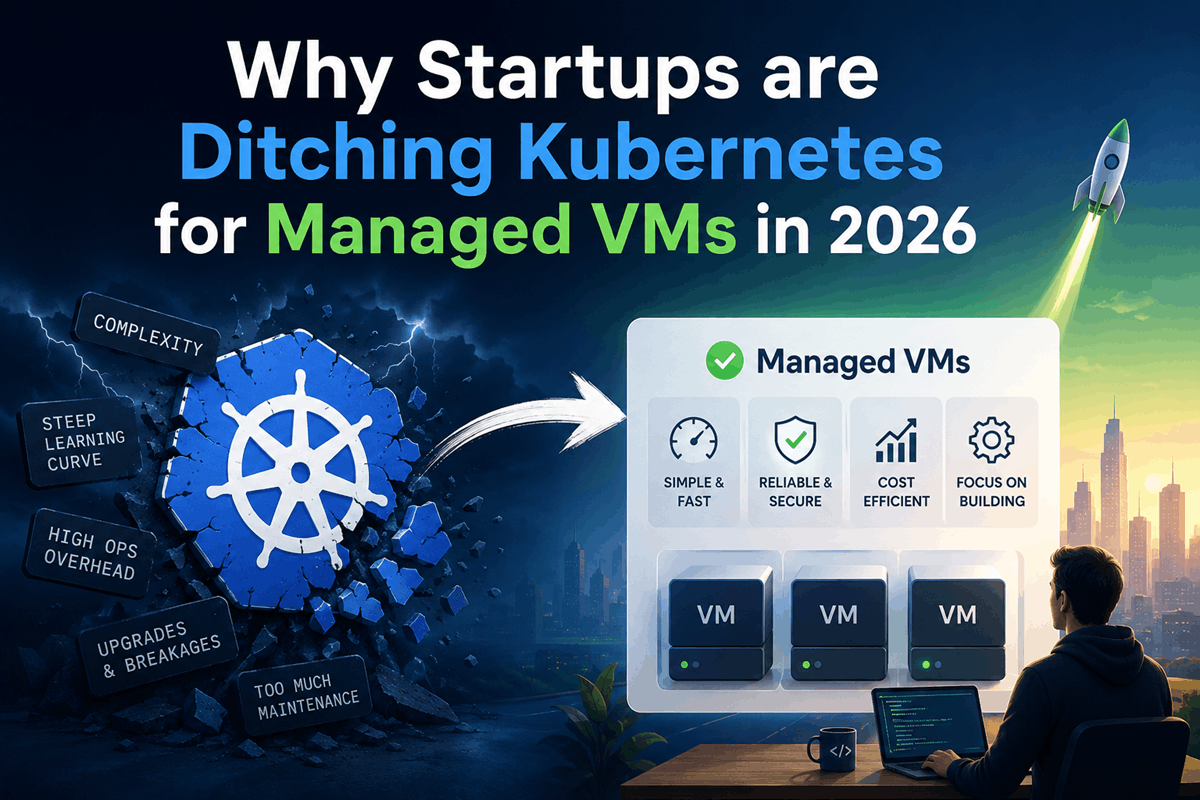
Kubernetes has become one of the most important infrastructure technologies of the last decade.
According to the CNCF's 2026 Annual Cloud Native Survey, 82% of container users now run Kubernetes in production, compared with 66% in 2023. Kubernetes is no longer an experimental technology—it has become a standard platform for modern infrastructure.
So why are more engineering teams questioning whether they actually need it?
The answer isn't that Kubernetes stopped being useful.
The answer is simpler:
A startup can adopt a technology that is technically excellent and still be the wrong technology for its current stage.
For a small team running a monolithic SaaS application, a handful of APIs, background workers, and a database, Kubernetes can introduce an infrastructure layer that requires significant operational knowledge without delivering proportional business value.
Managed virtual machines offer another path.
Instead of building a container orchestration platform, a startup can deploy its application on managed VMs, put them behind a load balancer, connect them to managed databases, and scale the infrastructure as the business grows.
For many startups in 2026, that architecture is not old-fashioned.
It is simply appropriately sized infrastructure.
Quick Answer
Managed VMs can be a better choice than Kubernetes for startups when the application is relatively simple, the engineering team is small, and sophisticated container orchestration is not yet required.
Kubernetes is the stronger choice when a company has many services, multiple engineering teams, complex deployment workflows, advanced autoscaling requirements, multi-cluster infrastructure, or significant dependence on the Kubernetes ecosystem.
The decision should therefore not be:
"Is Kubernetes modern?"
It should be:
"Does our current infrastructure complexity justify Kubernetes?"
Kubernetes Is Not the Problem
Before comparing the two approaches, it is important to correct a common misconception.
Kubernetes is not inherently inefficient or unnecessary.
It solves real problems.
It provides:
- Container scheduling
- Service discovery
- Automated rollouts
- Self-healing workloads
- Horizontal scaling
- Declarative infrastructure
- Workload isolation
- Advanced networking
- Persistent storage orchestration
- A massive ecosystem of extensions and tooling
That explains its adoption.
The latest CNCF research shows Kubernetes production usage among container users has reached 82%.
For organizations operating complex distributed applications, Kubernetes can be an extremely valuable platform.
The question for startups is different.
Do they have those problems yet?
The Kubernetes Complexity Tax
Kubernetes itself is open source.
That does not mean running Kubernetes is free.
The economic cost is only one part of the equation.
There is also an operational cost.
A production Kubernetes environment can involve:
- Cluster management
- Nodes
- Pods
- Deployments
- Services
- Ingress
- ConfigMaps
- Secrets
- RBAC
- Network policies
- Persistent volumes
- Storage classes
- Helm
- Container registries
- Monitoring
- Logging
- Metrics
- Autoscaling
- Cluster upgrades
- Security policies
Then the ecosystem expands further.
A company may eventually add:
- Prometheus
- Grafana
- OpenTelemetry
- Argo CD
- Flux
- cert-manager
- Istio
- Cilium
- External Secrets
- KEDA
- Vault
None of these tools are inherently bad.
The problem is cumulative complexity.
A five-person engineering team can end up operating infrastructure that resembles the infrastructure department of a much larger organization.
Kubernetes Is Increasingly Mature and That Creates a Paradox
The interesting thing about 2026 is that Kubernetes is simultaneously becoming more successful and more specialized.
CNCF's 2026 survey says Kubernetes production usage has reached 82% among container users.
At the same time, CNCF's earlier research found that developers reported Kubernetes setup and management as time-consuming and resource-intensive. Some respondents also reported negative effects around cost and security.
This creates an important distinction:
Kubernetes adoption is growing.
That does not mean:
Every application should run on Kubernetes.
The technology is becoming a standard precisely because it solves difficult infrastructure problems.
But if your startup doesn't have those problems, you may be paying for complexity you don't need.
What Managed VMs Change
A managed VM takes a much simpler approach.
The cloud provider manages the physical infrastructure and provides the virtual machine.
You receive:
- CPU
- RAM
- Disk
- Network connectivity
- Root access
- Operating system control
You then run your application.
Instead of managing a Kubernetes cluster, you might have:
Internet
   |
Load Balancer
   |
+---------+---------+
|                   |
VM 1                VM 2
|                   |
+---------+---------+
          |
   Managed Database
That architecture can support a surprisingly large number of applications.
You can run:
- Node.js
- Python
- Django
- Laravel
- PHP
- Java
- Go
- Ruby
- Docker
- Nginx
- background workers
- cron jobs
- APIs
- SaaS applications
without introducing a Kubernetes control plane.
Managed VMs vs Kubernetes
| Factor | Managed VMs | Kubernetes |
|---|---|---|
| Initial complexity | Low | High |
| Learning curve | Low–medium | High |
| OS control | Full | Node-level |
| Container orchestration | Manual/tool-based | Native |
| Autoscaling | Provider/application dependent | Advanced |
| Service discovery | Simple/manual | Built-in ecosystem |
| Deployment complexity | Low | Medium–high |
| Debugging | Usually simpler | More layers |
| Small teams | Excellent fit | Often excessive |
| Large microservice platforms | Limited | Excellent |
| Multi-cluster | Limited | Excellent |
| Kubernetes ecosystem | No | Yes |
| Operational overhead | Lower | Higher |
| Flexibility | High | Very high |
The important point is not that VMs win every category.
They don't.
Kubernetes wins when the complexity it introduces solves an even larger complexity problem.
Why Startups Are Looking at Simpler Infrastructure
1. Engineering teams are small
Early-stage startups often have engineers doing several jobs simultaneously.
The same person may be responsible for:
- backend development
- infrastructure
- deployments
- databases
- security
- monitoring
Adding Kubernetes means adding another technical system to understand and maintain.
A managed VM can reduce that surface area.
2. Most startup applications start simpler than they end
A typical early SaaS application might initially look like:
Frontend
   |
API
   |
PostgreSQL
Then it becomes:
Frontend
   |
Load Balancer
   |
API VMs
   |
PostgreSQL
   |
Redis
   |
Worker
You still may not need Kubernetes.
The infrastructure has become more sophisticated, but not necessarily complex enough to require container orchestration.
3. Infrastructure complexity has an opportunity cost
Every hour spent maintaining infrastructure is an hour not spent building the product.
That doesn't mean infrastructure work is unimportant.
It means infrastructure should be proportional to the company's current needs.
If engineers spend Friday afternoon debugging:
- ingress configuration
- Helm deployments
- cluster networking
- pod scheduling
- storage provisioning
while customers are waiting for product features, the company has to ask whether that complexity is justified.
The Cost Argument Is More Complicated Than "VMs Are Cheaper"
This is where many articles get the analysis wrong.
You cannot honestly say:
"VMs are always cheaper than Kubernetes."
Kubernetes itself is open source, and managed Kubernetes services can be cost-effective at scale.
For example, Amazon EKS currently charges $0.10 per cluster-hour during standard support, before the underlying compute and other AWS resources are included. Extended support can cost more.
The bigger issue is total cost.
A Kubernetes deployment may involve:
- control-plane charges
- worker nodes
- load balancing
- persistent storage
- networking
- observability
- logging
- security tooling
- engineers maintaining the platform
A VM deployment may have:
- VM costs
- storage
- networking
- monitoring
- managed database costs
Therefore, the right comparison is:
not simply:
When Managed VMs Make More Sense
Managed VMs are particularly attractive for workloads such as:
Monolithic SaaS applications
If your application is one deployable unit, Kubernetes may provide more orchestration than you need.
A VM with Docker or a traditional process manager can be sufficient.
APIs
A handful of API instances behind a load balancer can provide:
- redundancy
- horizontal scaling
- health checks
- rolling deployments
without requiring Kubernetes.
Background workers
Many background workers don't require sophisticated scheduling.
A dedicated VM can run:
- queue workers
- cron jobs
- scheduled processing
- data pipelines
- background tasks
Internal applications
Internal dashboards, admin tools, business applications, and internal APIs often have predictable workloads.
Kubernetes may be difficult to justify for them.
Development and staging
Non-production infrastructure is an especially strong candidate for simplicity.
There is little value in building an elaborate platform for an environment that developers use intermittently.
Managed VMs Don't Mean "No Automation"
This is another important misconception.
Choosing VMs doesn't mean returning to manually configuring servers.
A modern VM architecture can use:
- Infrastructure as Code
- Terraform
- Ansible
- Docker
- GitHub Actions
- GitLab CI
- automated backups
- monitoring
- health checks
- load balancers
- automated deployments
You can automate almost everything that matters without adopting Kubernetes.
The difference is the abstraction layer.
With Kubernetes:
You automate an orchestration platform.
With managed VMs:
You automate the application and servers directly.
For smaller systems, the second model can be dramatically easier to understand.
What Managed VMs Look Like on a Modern Cloud Platform
A modern managed VM platform doesn't have to mean "just rent a server."
For example, Neviri combines VMs with load balancers, VPC networking, firewalls, SSL, block storage, S3-compatible object storage, and managed databases in a single platform. Its current product catalog also includes managed MongoDB, MySQL, PostgreSQL, MariaDB, Redis, and RabbitMQ.
That creates an architecture like:
                 Internet
                     |
               Load Balancer
                     |
          +----------+----------+
          |                     |
       VM/API                 VM/API
          |                     |
          +----------+----------+
                     |
              Private VPC
                     |
       +-------------+-------------+
       |             |             |
   PostgreSQL      Redis        Object Storage
The startup still gets:
- isolated networking
- managed databases
- backups
- load balancing
- monitoring
- storage
- security controls
without having to operate Kubernetes simply to deploy the application.
The Bigger Opportunity: Managed Infrastructure
The real alternative to Kubernetes isn't necessarily:
It is:
A startup can choose:
Option 1 — Self-managed Kubernetes
Maximum flexibility, maximum operational responsibility.
Option 2 — Managed Kubernetes
Less infrastructure responsibility, but still a Kubernetes-based architecture.
Option 3 — Managed VMs + managed services
Less orchestration complexity while retaining significant infrastructure control.
Option 4 — PaaS
Maximum developer simplicity, less infrastructure control.
The correct choice depends on the application.
When Kubernetes Is Still the Right Choice
This article should not convince startups to avoid Kubernetes blindly.
Kubernetes is the better choice when the infrastructure actually needs its capabilities.
Consider Kubernetes when you have:
Many microservices
If your application has dozens or hundreds of independently deployed services, orchestration becomes increasingly valuable.
Multiple engineering teams
Kubernetes can provide a standardized platform for many development teams.
Complex autoscaling
If workloads scale dynamically across many services, Kubernetes provides sophisticated scheduling and autoscaling mechanisms.
Multi-cluster infrastructure
Kubernetes is much stronger when managing complex distributed environments.
Multi-cloud requirements
Kubernetes can provide a common orchestration layer across different infrastructure providers.
Kubernetes-native tooling
If your organization depends heavily on:
- Helm
- Operators
- Argo
- Istio
- Cilium
- KEDA
- Kubernetes-native security policies
moving away may create more problems than it solves.
AI/GPU infrastructure
Kubernetes is increasingly important for AI infrastructure. CNCF's 2026 research reports that 66% of AI adopters use Kubernetes for inference workloads.
For sophisticated AI infrastructure, Kubernetes can therefore be entirely justified.
A Simple Decision Framework
Ask these seven questions.
1. How many engineers operate the infrastructure?
If the answer is one or two, simplicity has enormous value.
2. How many production services do you run?
Five services and 100 services are very different infrastructure problems.
3. Do you require sophisticated autoscaling?
If not, simpler scaling mechanisms may be enough.
4. Do you require multiple clusters?
If no, Kubernetes may be unnecessary.
5. Do you depend on Kubernetes-native tooling?
If yes, switching becomes harder to justify.
6. How much infrastructure complexity can your team absorb?
This is often ignored.
7. Is infrastructure helping the business or consuming engineering capacity?
This is ultimately the most important question.
A Practical Startup Architecture in 2026
For many early-stage SaaS companies, a reasonable architecture can look like:
                   Users
                      |
                Load Balancer
                      |
              +-------+-------+
              |               |
           VM #1           VM #2
              |               |
              +-------+-------+
                      |
                Private VPC
                      |
          +-----------+-----------+
          |           |           |
       Postgres     Redis       Storage
          |
       Backups
As the application grows, additional VMs can be added.
Eventually, if the system becomes sufficiently complex, Kubernetes can be introduced.
The important thing is to make that decision based on actual requirements rather than anticipated complexity.
Can You Start With VMs and Move to Kubernetes Later?
Yes.
In fact, designing for migration can be a sensible startup strategy.
Keep your application:
- containerized where useful
- stateless where possible
- configuration-driven
- backed by managed databases
- separated from the host filesystem
- automated through CI/CD
Then your application isn't tightly coupled to a particular deployment model.
You can start with:
and later move to:
when the operational benefits justify the transition.
The mistake is not starting with VMs.
The mistake is building an architecture that makes future change unnecessarily difficult.
The Real Lesson for Startup CTOs
The infrastructure industry has spent years optimizing for maximum scalability.
Startups often need to optimize for something else:
maximum velocity per engineer.
There is a difference.
A 10-person startup doesn't necessarily benefit from operating infrastructure designed for a 1,000-person engineering organization.
That doesn't make Kubernetes bad.
It means architecture should follow the workload.
The best infrastructure is not the infrastructure with the most features.
It is the infrastructure that solves your current problems while leaving you room to grow.
Why Managed VMs Are Interesting in 2026
The 2026 infrastructure conversation isn't really about returning to old-fashioned servers.
It is about finding the right abstraction.
Kubernetes has become a standard because modern applications genuinely need orchestration at scale.
But the growing ecosystem of Kubernetes alternatives also reflects a different reality: many teams want the benefits of modern cloud infrastructure without operating every layer themselves. Current 2026 comparisons increasingly emphasize simpler alternatives for smaller teams and workloads.
Managed VMs occupy an interesting middle ground.
They provide more control than a traditional PaaS while requiring substantially less orchestration than Kubernetes.
For startups, that can be a powerful combination.
FAQ Section
1. Is Kubernetes overkill for startups?
It can be. Small teams running relatively simple applications may not need Kubernetes' orchestration capabilities. A managed VM architecture can provide sufficient reliability and scalability with less operational complexity.
2. Are startups abandoning Kubernetes in 2026?
No broad abandonment trend is established. Kubernetes production adoption continues to rise, reaching 82% among container users in CNCF's 2026 survey. The more defensible trend is increased scrutiny over whether Kubernetes is appropriate for smaller workloads.
3. Are managed VMs cheaper than Kubernetes?
Not necessarily. Kubernetes itself is open source, and managed Kubernetes can be economical. The comparison should include compute, networking, storage, monitoring, management costs, and engineering time.
4. What is a managed VM?
A managed VM is a virtual machine provided through a cloud infrastructure platform where the provider manages the underlying physical infrastructure while the customer manages the operating system and applications.
5. Can a startup run production SaaS on VMs?
Yes. SaaS applications can run reliably on VMs using load balancing, multiple instances, automated backups, monitoring, private networking, and managed databases.
6. Can VMs scale horizontally?
Yes. Multiple VMs can run behind a load balancer. Additional instances can be provisioned as traffic increases.
7. Does using VMs mean manually managing servers?
No. Infrastructure automation can be implemented with Terraform, Ansible, CI/CD systems, Docker, cloud APIs, monitoring and automated provisioning.
8. When should a startup adopt Kubernetes?
Consider Kubernetes when you have substantial microservice complexity, multiple engineering teams, advanced autoscaling requirements, multi-cluster infrastructure, or significant reliance on Kubernetes-native tooling.
9. Can you migrate from VMs to Kubernetes?
Yes. Containerizing applications and separating application state from individual servers can make a later migration easier.
10. Is Kubernetes more scalable than VMs?
Kubernetes provides significantly more sophisticated orchestration and scheduling capabilities. But a VM architecture can scale to substantial workloads when combined with load balancing, automation, and appropriate application architecture.
11. What is the biggest disadvantage of managed VMs?
The main disadvantage is that VMs do not provide Kubernetes' built-in orchestration capabilities. Complex microservice environments may eventually require a more sophisticated platform.
12. What is the biggest disadvantage of Kubernetes for startups?
Operational complexity. Teams may need expertise in networking, storage, security, observability, deployments, cluster upgrades and the broader Kubernetes ecosystem.
13. Is managed Kubernetes better than managed VMs?
Neither is universally better. Managed Kubernetes reduces some operational work but retains the Kubernetes abstraction. Managed VMs are usually simpler when the workload doesn't require orchestration.
14. Can Docker run on a VM?
Yes. Docker can be installed on a VM and used to package and deploy applications without Kubernetes.
15. Should a startup use Docker without Kubernetes?
For many small applications, yes. Docker can provide application packaging and deployment consistency without requiring a Kubernetes cluster.
16. Do AI startups need Kubernetes?
Not automatically. Simple AI applications may run perfectly well on VMs or specialized platforms. More complex GPU scheduling, distributed inference, multi-service AI systems, and large-scale workloads can justify Kubernetes.
17. What is better for a five-person engineering team?
There is no universal answer, but a small team with a few production services should seriously evaluate simpler architectures before adopting Kubernetes.
18. What is better for a 100-person engineering organization?
Kubernetes becomes more compelling as the number of services, teams, environments and infrastructure requirements increases.
19. Is Kubernetes still worth learning in 2026?
Absolutely. Kubernetes remains one of the dominant technologies for modern cloud infrastructure, with production usage continuing to grow.
20. What should a startup optimize first: infrastructure or product?
Product velocity should generally come first. Infrastructure should be reliable enough to support the product without consuming disproportionate engineering capacity.
Final Verdict
Startups are not "ditching Kubernetes."
That headline is too aggressive and the available evidence doesn't support it.
What is happening is more nuanced:
Startups are becoming more deliberate about whether Kubernetes is justified by their actual infrastructure requirements.
For a small team running a straightforward SaaS application, managed VMs can provide:
- simpler operations
- predictable infrastructure
- full server control
- easier debugging
- lower platform complexity
- straightforward scaling
- faster deployment
Kubernetes becomes the stronger choice when infrastructure complexity itself becomes the problem that Kubernetes solves.
The strategic rule is simple:
Don't adopt Kubernetes because you're afraid your startup will outgrow a simpler architecture. Adopt Kubernetes when your current architecture has actually become too difficult to operate.
Start with the simplest production architecture that can reliably support the business.
Then add complexity when the business earns the right to need it.
That isn't anti-Kubernetes.
It's good infrastructure engineering.