Cloud Isn't Expensive. Waste Is.
Why your cloud bill isn't the problem—your cloud habits are.
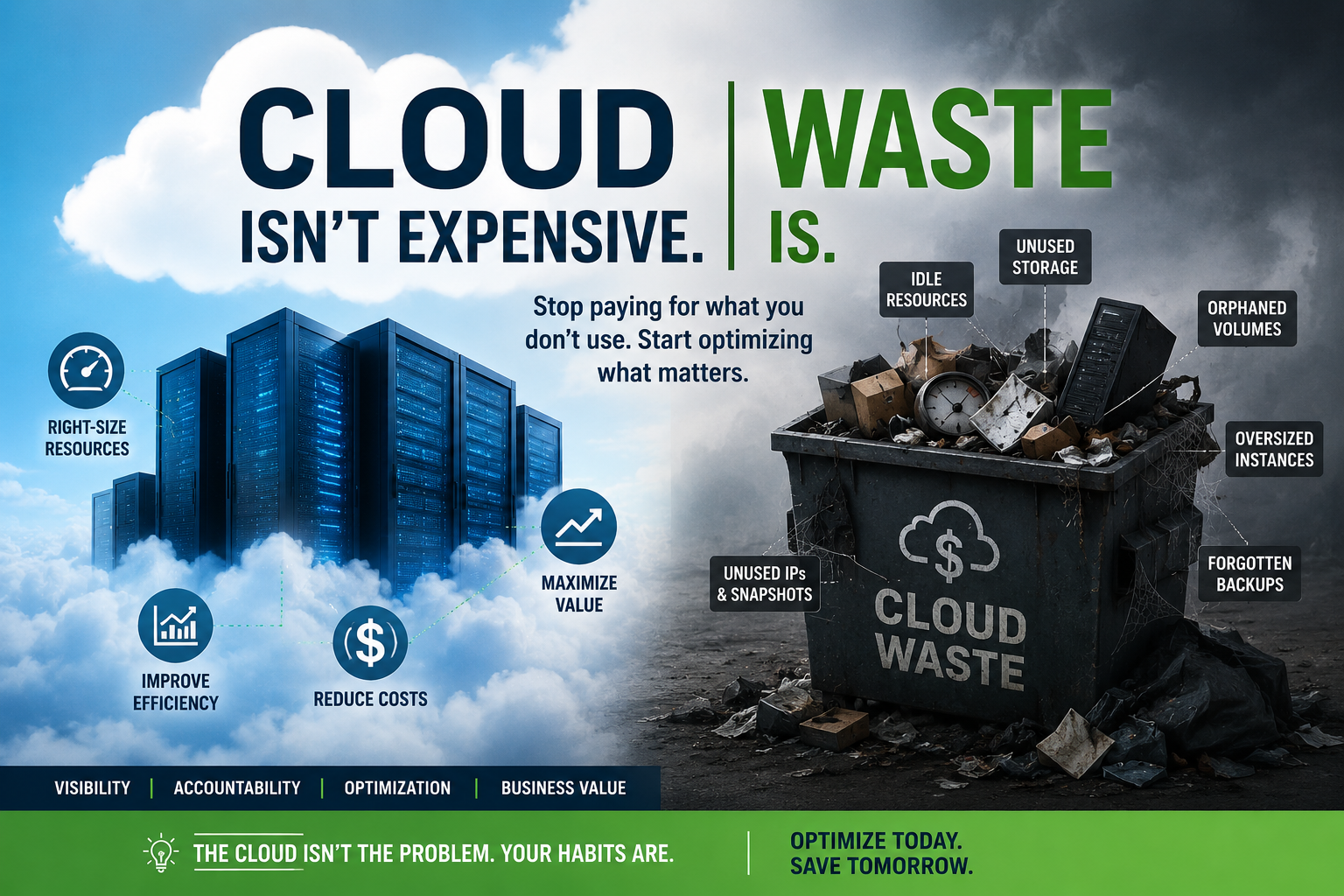
For years, cloud computing has been blamed for rising IT costs.
Executives see invoices growing month after month. Finance teams question whether moving to the cloud was worth it. Engineering teams feel pressured to reduce spending without sacrificing performance.
The conclusion is almost always the same:
"Cloud is expensive."
But that's usually the wrong conclusion.
Cloud isn't expensive.
Waste is.
The cloud charges you for what you consume. When organizations consume more than they need or fail to manage what they've already provisioned, they're paying for inefficiency, not innovation.
The companies that achieve the greatest return on cloud investments don't necessarily spend less because cloud providers are cheaper. They spend less because they eliminate waste before it becomes a recurring cost.
This shift in thinking is at the heart of modern FinOps and cloud cost optimization.
The Biggest Myth About Cloud Computing
Traditional data centers require organizations to purchase infrastructure upfront.
The cloud changed that model.
Instead of buying servers, organizations rent computing power, storage, databases, networking, and managed services on demand.
This flexibility is one of cloud computing's greatest strengths, but it's also where waste begins.
Every virtual machine left running overnight, every oversized database, every unused storage volume, and every forgotten development environment continue generating costs.
Cloud pricing is transparent.
Waste isn't.
What Is Cloud Waste?
Cloud waste is spent on resources that provide little or no business value.
Common examples include:
- Idle virtual machines
- Overprovisioned Kubernetes clusters
- Unattached storage volumes
- Obsolete snapshots and backups
- Unused IP addresses
- Development environments running after business hours
- Underutilized databases
- Excessive log retention
- Duplicate environments
- Poorly optimized data transfer
None of these costs exist because cloud providers are overpriced.
They exist because organizations lack visibility, governance, or accountability.
The Hidden Sources of Cloud Waste
1. Idle Resources
Development teams often provision resources for testing and simply forget about them.
A single virtual machine may seem inexpensive.
Hundreds of forgotten instances across multiple teams become a recurring operational expense.
2. Overprovisioning
Many workloads are sized for peak demand rather than actual usage.
An application consuming only 20% of available CPU still incurs the cost of the entire instance.
Rightsizing resources based on utilization is one of the fastest ways to reduce unnecessary spending.
3. Always-On Infrastructure
Not every workload needs to run 24 hours a day.
Development, testing, and staging environments often remain active overnight, on weekends, and during holidays even when no one is using them.
Automated scheduling can significantly reduce costs without affecting productivity.
4. Storage That Never Gets Deleted
Storage appears inexpensive on a per-gigabyte basis.
Over time, forgotten snapshots, obsolete backups, duplicate files, and outdated datasets accumulate substantial recurring costs.
Without lifecycle policies, storage continues to grow indefinitely.
5. Poor Resource Tagging
When resources lack consistent ownership tags, organizations lose visibility into:
- Who created the resource
- Which application it supports
- Which department owns it
- Whether it still delivers business value
If nobody owns a resource, nobody feels responsible for deleting it.
The Real Cost Isn't Financial
Cloud waste affects far more than infrastructure budgets.
It creates:
- Slower engineering decisions
- Reduced operational visibility
- Security risks from forgotten assets
- Increased compliance complexity
- Lower return on cloud investments
- Poor financial forecasting
Waste compounds over time.
Every unnecessary resource adds operational complexity alongside financial costs.
A Better Way to Think About Cloud Costs
Instead of asking:
"How do we reduce our cloud bill?"
Ask:
"Which resources are creating business value, and which are creating waste?"
This subtle shift changes everything.
Successful organizations optimize value—not simply lower spending.
The V.O.I.C.E. Framework for Sustainable Cloud Cost Optimization
V — Visibility
You can't optimize what you can't see.
Create centralized dashboards that provide real-time visibility into cloud spending by application, environment, business unit, and team.
O — Ownership
Every cloud resource should have an owner.
Ownership creates accountability.
Accountability reduces waste.
I — Intelligence
Use utilization data—not assumptions—to make infrastructure decisions. Measure CPU, memory, storage, network traffic, and application demand before resizing workloads.
C — Control
Implement governance policies that prevent unnecessary spending before it happens.
Examples include:
- Mandatory tagging
- Budget alerts
- Automated shutdown schedules
- Infrastructure policies
- Cost anomaly detection
E — Efficiency
Optimization is not a one-time project.
It is a continuous engineering discipline.
High-performing organizations review cloud usage regularly and embed cost awareness into architecture reviews, deployment pipelines, and sprint planning.
Practical Ways to Reduce Cloud Waste
Organizations can often realize meaningful savings without reducing innovation by adopting a disciplined approach to cloud governance.
Start with these actions:
- Right-size compute instances based on actual utilization.
- Schedule non-production environments to shut down outside working hours.
- Delete orphaned storage volumes and obsolete snapshots.
- Use auto scaling instead of permanent overprovisioning.
- Review database sizing and storage classes regularly.
- Implement lifecycle policies for object storage.
- Standardize resource tagging across every cloud account.
- Configure cost anomaly detection and budget alerts.
- Evaluate reserved capacity or savings plans for predictable workloads.
- Conduct monthly FinOps reviews with engineering and finance teams together.
Why FinOps Matters
FinOps is not simply about reducing cloud spending.
It creates a shared operating model where engineering, finance, and business leaders collaborate to maximize the value of every cloud dollar.
Engineering gains the flexibility to innovate.
Finance gains predictability.
Leadership gains confidence that cloud investments support measurable business outcomes.
The Future of Cloud Cost Management
As organizations adopt AI workloads, containers, serverless platforms, and multi-cloud architectures, managing cloud spend will become even more complex.
The organizations that succeed won't necessarily spend the least.
They'll waste the least.
Cloud providers will continue delivering new services.
The competitive advantage won't come from choosing the cheapest provider.
It will come from building a culture where every resource has a purpose, every workload has an owner, and every dollar spent creates measurable business value.
Frequently Asked Questions (FAQs)
Is cloud computing really expensive?
Cloud computing is not inherently expensive. Most organizations overspend because of inefficient resource usage, such as idle virtual machines, oversized infrastructure, unused storage, and poor governance. The cloud's pay-as-you-go model is cost-effective when resources are actively managed.
What is cloud waste?
Cloud waste refers to cloud resources and services that incur costs without delivering meaningful business value. Examples include unused virtual machines, unattached storage volumes, obsolete snapshots, overprovisioned databases, and forgotten development environments.
Why do cloud bills keep increasing?
Cloud bills often increase because organizations continue adding new workloads without regularly reviewing existing resources. Common causes include infrastructure sprawl, lack of cost visibility, inefficient architectures, growing storage requirements, and insufficient governance.
What is cloud cost optimization?
Cloud cost optimization is the process of reducing unnecessary cloud spending while maintaining or improving application performance, reliability, and scalability. It involves rightsizing resources, automating operations, implementing governance policies, and continuously monitoring usage.
What is FinOps, and why is it important?
FinOps is a cloud financial management practice that brings engineering, finance, and business teams together to make informed decisions about cloud spending. It improves cost visibility, accountability, forecasting, and operational efficiency while supporting business growth.
What are the biggest causes of cloud waste?
The most common causes of cloud waste include:
- Idle virtual machines
- Overprovisioned compute resources
- Unused storage volumes
- Forgotten snapshots and backups
- Development environments running after hours
- Poor resource tagging
- Duplicate infrastructure
- Inefficient data transfer
How can organizations reduce cloud costs without affecting performance?
Organizations can reduce cloud costs by rightsizing workloads, enabling auto scaling, deleting unused resources, scheduling non-production environments to shut down automatically, optimizing storage tiers, and continuously monitoring infrastructure utilization. These measures improve efficiency without compromising performance.
How often should cloud infrastructure be optimized?
Cloud infrastructure should be reviewed continuously, with formal optimization reviews conducted at least once a month. Automated monitoring and cost anomaly detection can help identify inefficiencies as they occur rather than waiting for monthly billing cycles.
What is rightsizing in cloud computing?
Rightsizing is the process of matching cloud resources to actual workload requirements. Instead of paying for oversized infrastructure, organizations adjust compute, memory, storage, and database capacity based on real utilization data.
Does auto scaling reduce cloud costs?
Yes. Auto scaling helps reduce costs by automatically increasing resources during periods of high demand and decreasing them when demand falls. This prevents organizations from paying for idle capacity while maintaining application performance.
Which cloud provider is the cheapest: AWS, Microsoft Azure, or Google Cloud?
There is no universally cheapest cloud provider. Costs depend on workload design, usage patterns, pricing models, regions, and available discounts. Efficient architecture and good governance generally have a greater impact on cloud spending than the choice of provider.
How does resource tagging help control cloud costs?
Resource tagging assigns metadata such as owner, department, project, or environment to cloud resources. Consistent tagging improves cost allocation, increases accountability, simplifies reporting, and helps identify unused or unnecessary infrastructure.
What are Reserved Instances and Savings Plans?
Reserved Instances and Savings Plans allow organizations to receive discounted pricing in exchange for committing to a predictable level of cloud usage over a defined period. They are most effective for stable, long-running workloads.
What are the signs that an organization has excessive cloud waste?
Common warning signs include:
- Rapidly increasing monthly cloud bills
- Low resource utilization
- Numerous idle or orphaned resources
- Inconsistent tagging
- Unexpected billing spikes
- Duplicate environments
- Limited visibility into who owns cloud resources
What metrics should organizations monitor for cloud cost optimization?
Key metrics include:
- Resource utilization (CPU, memory, and storage)
- Cost per application
- Cost by business unit
- Idle resource percentage
- Monthly cloud spend
- Reserved capacity utilization
- Storage growth
- Cost anomalies
- Unit cost per customer or transaction
Can small businesses benefit from FinOps?
Yes. FinOps is valuable for organizations of all sizes. Small businesses can establish cost-conscious practices early, improving budgeting, reducing unnecessary spending, and creating a scalable foundation as cloud usage grows.
Is cloud cost optimization a one-time project?
No. Cloud environments change constantly as applications evolve, teams deploy new services, and workloads scale. Effective cloud cost optimization is an ongoing process that combines monitoring, governance, automation, and continuous improvement.
What's the difference between reducing cloud costs and reducing cloud waste?
Reducing cloud costs focuses on lowering overall spending, while reducing cloud waste focuses on eliminating unnecessary or low-value spending. Organizations that eliminate waste often achieve lower costs without sacrificing performance, reliability, or innovation.
How does cloud governance help control spending?
Cloud governance establishes policies, standards, and controls for provisioning, monitoring, and managing cloud resources. Strong governance reduces unnecessary spending by enforcing tagging standards, budget controls, approval workflows, security policies, and lifecycle management.
What is the most important takeaway about cloud costs?
The biggest driver of cloud spending is rarely the cloud platform itself. Most organizations spend more than necessary because of waste created by idle resources, poor visibility, and weak governance. Improving accountability and operational discipline typically delivers greater savings than simply choosing a different cloud provider.
Key Takeaways
Cloud computing is not inherently expensive.
Poor governance is.
Waste grows silently through idle resources, oversized infrastructure, forgotten environments, and limited cost visibility.
Organizations that combine engineering discipline with financial accountability consistently outperform those focused solely on cutting costs.
The question isn't whether you're spending more on clouds.
The question is whether every dollar you spend is delivering value.
Because clouds aren't expensive.
Waste is.