Managed PostgreSQL vs Self-Hosted PostgreSQL: Which Should You Choose?
Nov 13, 2026 • 8 min read
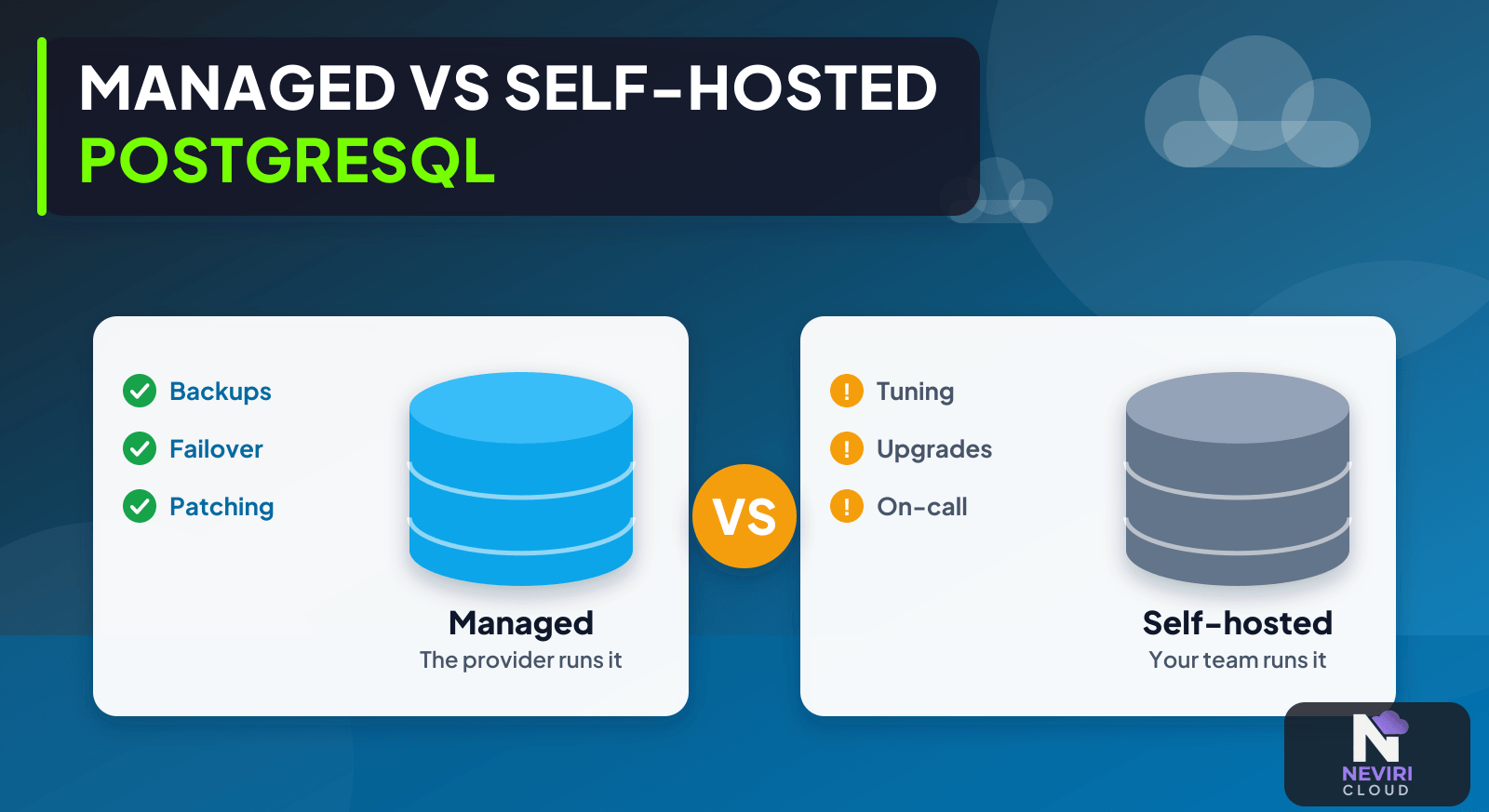
Running PostgreSQL yourself can look like the cheaper choice until you ask who will handle the awkward parts. Who patches it? Who checks the backups? Who gets the call if it stops accepting connections? I’d bring those questions into the price comparison early, especially if the same small team is also trying to ship the product.
Managed PostgreSQL can take defined maintenance tasks off your plate, provided the service fits your app and recovery needs. Running it yourself gives you more control, along with the patching, backups, monitoring, and incident work. Put those responsibilities beside the price before deciding which option suits your team.
Decide who owns the day-to-day work
- List required PostgreSQL versions, extensions, administrative permissions, and network access before comparing providers.
- Assign an owner for patching, backup retention, restore testing, failover decisions, and after-hours incidents.
- Price equivalent capacity and recovery arrangements, including storage, backup, bandwidth, and engineering time.
- Run an application and restore rehearsal with realistic data; retain the results alongside the commercial comparison.
What you take on with each PostgreSQL option
| Approach | Choose it when | Verification or tradeoff |
|---|---|---|
| Managed PostgreSQL | Limited database operations capacity | Verify exact included work and escalation boundaries. |
| Self-hosted VM | Required host-level control | Budget for supervision, maintenance, backup, and recovery. |
| Self-hosted orchestration | Existing operational expertise | Do not add a cluster solely to avoid a managed-service price. |
Which responsibilities must the comparison assign?
Write a responsibility table before collecting prices. “Managed” can describe different boundaries: a provider may operate the database service while the customer still owns schema changes, application permissions, data retention decisions, and the correctness of its queries. Ask for a concrete answer about each operation rather than interpreting the product label as a complete contract.
For self-hosting, distinguish tasks you already perform competently from tasks you merely intend to learn during an incident. Existing operating-system expertise helps, but it does not automatically establish a tested PostgreSQL restore procedure. A small team can self-host well when it has the necessary practices; a larger team can still lack a clear owner for them.
| Responsibility | Evidence to request from a managed service | Evidence needed for self-hosting |
|---|---|---|
| Version changes | Supported versions, maintenance process, and compatibility boundaries | An upgrade rehearsal and an application compatibility check |
| Backups | Retention, access, restoration method, and applicable service terms | Successful backup artifacts and repeatable restoration into a clean target |
| Capacity | Available resources, limits, and resizing behaviour | Measurements of workload demand and a tested capacity-change procedure |
| Incidents | Escalation route and the actions the provider owns | A named responder with the access and knowledge to recover |
| Data access | Supported network and authentication controls | Effective firewall, authentication, and credential-revocation checks |
How should the cost comparison value engineering work?
Keep the invoice and operating work visible as separate categories. Do not invent an hourly engineering rate to manufacture a saving, and do not assume time is free because an employee is salaried. Estimate effort from tasks your team can identify and review: maintenance preparation, backup verification, incident investigation, and capacity changes.
A useful decision can be qualitative when there is no reliable labour estimate. For example, your team may prefer to delegate a recurring operation because nobody is available to own it. Record that constraint directly. It is stronger reasoning than assigning a precise monetary value to hypothetical outages and presenting the result as measured total cost.
Compare equivalent recovery requirements. A single unreplicated VM with an untested backup is not operationally equivalent to a service with a documented recovery arrangement. Equally, a managed plan should not receive credit for a capability its current terms do not include. Build the comparison from the configuration actually being purchased.
Separate introductory rates from continued operation. A first-year discount can be commercially useful without determining which operating model is suitable. Check the regular-rate budget, storage growth, retained backups, and network charges before making the service difficult to leave.
What compatibility checks can rule out a provider early?
Inventory the features your app uses today, including extensions, collation assumptions, driver behaviour, administrative privileges, scheduled work, and the connection model. Test required features with the intended application identity. A connection using a privileged administrator account can hide permissions the ordinary service account will not have.
If your app needs a specific extension, confirm the available version and installation boundary. If it depends on a host-level agent, establish whether that agent can run in the selected operating model. Avoid choosing a provider first and discovering later that a critical dependency requires control the product intentionally does not expose.
Also check the exit path. Confirm how your team can export its data and obtain the credentials and permissions required for that export. A compatible PostgreSQL endpoint is useful, but backups, identity management, surrounding services, and commercial terms can still affect migration effort.
What is a practical evaluation exercise?
Create a realistic test database on each shortlisted arrangement. Restore the same approved dataset, use the same application version, and run the same important reads and writes. Record the versions and configuration so the comparison can be repeated rather than remembered as a subjective impression.
Include an operational task in the evaluation: restore a backup, change a permitted resource setting, or rotate an application credential. Observe the actual sequence and ownership. This is often more informative for a small team than a narrowly optimized throughput test that ignores the work of keeping the service usable.
Write the resulting decision in three parts: requirements met, responsibilities accepted, and unresolved limitations. A limitation can be acceptable if its business consequence is understood. The purpose is to make that acceptance explicit, rather than treating every difference between managed and self-hosted PostgreSQL as either a universal advantage or a universal defect.
The PostgreSQL backup documentation is a useful primary reference for the recovery mechanisms being compared. Use provider-specific terms separately for commercial scope; PostgreSQL's own documentation cannot prove what a particular managed plan includes.
How do you evaluate the support boundary during an incident?
Ask who takes the first action when your app cannot reach its database, when a restore fails, or when storage approaches its limit. A provider operating the database may still need the customer's application evidence to distinguish a service failure from a permission or query problem.
Keep a note of the escalation route, information required, and the work your team retains. Avoid treating a general support promise as a database recovery guarantee. A useful evaluation can include walking through an incident scenario with the proposed responsibilities and identifying which person has the authority and access to act.
This also makes the self-hosted alternative more concrete. Name the person or rotation that would perform those same actions and the procedure they would follow. Comparing accountable operating arrangements is more informative than assuming a managed service removes every incident task or that an existing engineer can absorb unlimited database work.
Managed still leaves decisions with your team
The decision is ownership of operational work. A database process on an inexpensive VM and a managed service are not equivalent offers unless the comparison identifies who performs upgrades, investigates failures, and proves restoration. Neither label removes application-side responsibility for schema changes, query efficiency, connection budgets, and access permissions.
Questions you might have
Is self-hosted PostgreSQL always cheaper?
A lower server price does not prove a lower complete operating cost. Include backups, replicas, monitoring, engineering time, and incident exposure in the comparison. Self-hosting can be appropriate where those capabilities already exist, but the decision should make that capacity explicit rather than treating operational work as free.
Does a managed database remove backup responsibility?
Managed operation does not remove your need to verify recovery requirements and results. Confirm retention, restoration options, access to backups, and the provider’s responsibilities. Your team still needs to know whether restored application data is correct and fresh enough, and whether recovery fits the business’s required window.
When is self-hosting a sensible choice?
Self-hosting is sensible when its control benefits justify the operational work your team can actually perform. Examples include a required unsupported extension or a host-level integration. Document who owns routine maintenance and failure recovery, then test that ownership with a restore drill rather than relying on hypothetical expertise.
Keep reading
Database Cutover Rollback After New Writes: Preserve Accepted Changes; Database Backups Are Only Useful If You Can Restore Them; PostgreSQL Connection Pooling: Prevent Connection Exhaustion; How Much Does It Cost to Host a SaaS Application?; SaaS Disaster Recovery Plan: Prove Recovery Beyond the Backup Job.
Choose the responsibility you can carry
Choose the arrangement your team can operate on an ordinary week and recover during a bad one. If you go managed, check exactly what the service includes. If you self-host, give maintenance and restore testing a place on the calendar. Either choice becomes easier to defend when the responsibility is clear.
Sources and further reading
PostgreSQL documentation distinguishes SQL dumps, filesystem-level backups, and continuous archiving as separate backup approaches. PostgreSQL documentation.
Best approach for running a PostgreSQL database describes a related situation: A PostgreSQL discussion frames the hosting decision around ownership of updates, patches, and backup operations.