How Much Does It Cost to Host a SaaS Application?
Nov 13, 2026 • 6 min read
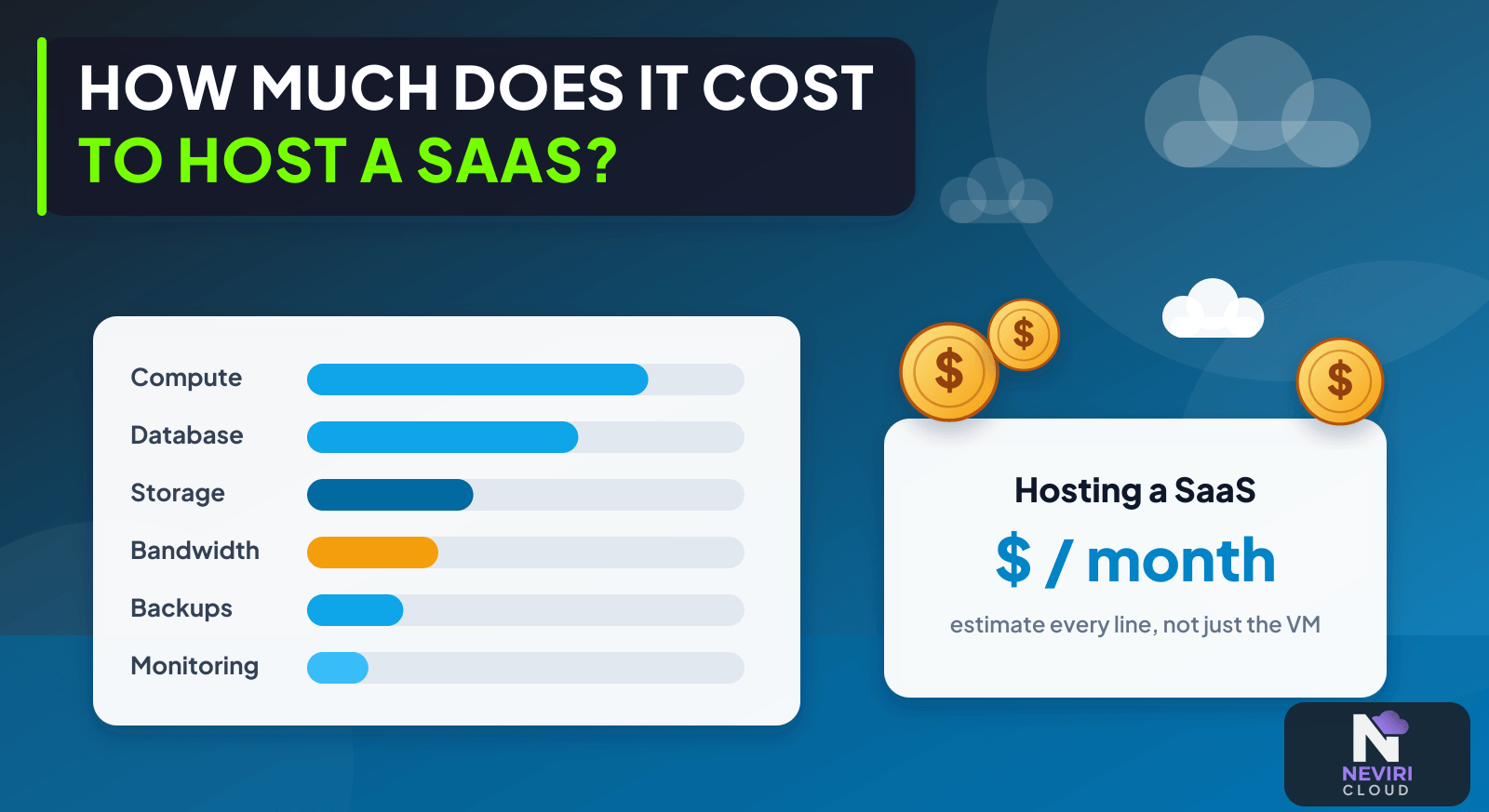
If you’re working out a SaaS budget, it’s tempting to start with a server price and call it the hosting cost. I’d use that as one line in the budget. Your database, backups, traffic, and the time needed to keep everything running can change the picture quite a bit as customers arrive.
Price the whole app: servers, database, stored data, backups, traffic, and the work of running it. Make one estimate for your starting workload and another for growth, using quantities you can explain. Keep discounts separate, then compare the forecast with real usage once customers begin using the product.
Build the budget around your application
- Inventory web processes, workers, databases, files, backups, environments, and external paid dependencies.
- Estimate concurrency, retained data, transfer, and operating hours; label assumptions rather than disguising them as measurements.
- Calculate baseline, growth, and surge scenarios using current rates and confirmed allowances.
- Compare forecast and actual usage regularly, including a regular-rate view after any promotion expires.
Where your hosting budget goes
| Approach | Choose it when | Verification or tradeoff |
|---|---|---|
| Minimal single environment | A prototype with low recovery requirements | Keep the limitations explicit. |
| Managed data services | A small team values defined operational help | Check resource, backup, and connection costs. |
| Multiple environments and replicas | Release or availability requirements justify them | Count each retained resource and operational responsibility. |
How do you turn a resource list into a useful cost model?
Separate resource quantities from their unit rates. For each component, write the billing unit, expected consumption, current rate, and any allowance or commitment. This allows a reviewer to distinguish a price change from a usage change and prevents a monthly headline figure from hiding different assumptions.
Include compute, database resources, persistent storage, backup retention, network transfer, and any separately charged operational services. Count environments as well as production replicas. A staging database, retained volume, or temporary migration target can continue to contribute cost even when the public application has little traffic.
Use a baseline, a growth case, and a failure or surge case. These are planning scenarios, not predictions. Label illustrative numbers and keep the same workload assumptions when comparing providers. A cheaper compute line does not establish a cheaper complete application if transfer, storage, or operating responsibilities differ.
Apply discounts only to eligible usage and show the regular-rate view beside the promotional view. Keep taxes, credits, support, and one-time migration work in explicit categories rather than silently mixing them into the rate. Check the current terms before assuming that an allowance or discount applies to every component.
Review the forecast against observed usage at a defined interval. Connect cost changes to application activity such as active customers, completed jobs, or retained data. The useful outcome is an explainable cost per unit of product value, not merely a percentage saving without a consistent baseline.
What should a first budget worksheet contain?
Use one row per cost driver, not one row per vendor marketing category. A web process and a background worker can consume the same kind of VM while following different operating schedules. Separate them if that difference changes the estimate.
| Worksheet field | Example of the information to record | Why it changes the decision |
|---|---|---|
| Workload owner | Product API, file processing, or scheduled export | Explains who can confirm whether usage is necessary |
| Quantity assumption | Running hours, retained data, or transferred data | Makes the estimate reproducible |
| Unit price and date | The current published rate or a valid quote | Prevents old and new rates being mixed silently |
| Environment | Production, staging, development, or a temporary migration target | Exposes resources beyond the customer-facing service |
| Discount scope | Eligible usage and its end date | Keeps regular operation visible after the incentive ends |
For an early estimate, make uncertainty a field rather than a hidden multiplier. A retained database may have a reasonably clear minimum configuration while outgoing traffic remains uncertain. Give those assumptions different confidence levels and specify which measurements will improve them after launch.
Do not treat a vendor's smallest advertised price as the completed worksheet. It may describe one component while the product also needs storage, a database, and a recovery arrangement. Conversely, do not buy an elaborate multi-service architecture simply because a reference diagram includes it. Price the components justified by the product's actual operating requirements.
The FinOps forecasting guidance supports connecting forecasts to their business and usage drivers. The worksheet becomes useful when a reviewer can explain why a quantity changed, which team owns it, and whether the change supports customer activity.
For each forecast update, retain the assumption that changed. This makes a larger estimate explainable: more retained data, a second environment, or a different recovery requirement is different from an unnoticed rate change. A useful budget should survive review by someone who did not build the first spreadsheet.
The bill changes when the workload changes
There is no defensible universal monthly price for a SaaS application without workload assumptions. A small service can have meaningful fixed infrastructure costs even at low traffic. Begin with the shape of requests and retained data, not a popular VM size or an unrelated company’s bill.
Questions you might have
What should the budget include?
Include every resource needed to operate and recover your app, not only its web server. Count database capacity, persistent storage, backups, outgoing traffic, monitoring, and separate environments. Keep engineering work and one-time migration expenses visible so the estimate explains both the invoice and the effort required to sustain it.
How can I estimate costs before launch?
Use explicit workload scenarios and revise them with measurements from a realistic test. State the expected traffic, concurrency, data growth, and retained environments. Choose resource configurations that support those assumptions, calculate their current charges, and keep uncertainty visible rather than presenting an untested capacity estimate as a guaranteed bill.
Why does a tiny app still have fixed costs?
Some infrastructure is retained whether or not requests arrive. A database, network endpoint, persistent volume, or staging environment can contribute costs at low traffic, depending on its billing model. Separate retained capacity from usage-sensitive charges so you can see which costs scale down and which require a design decision.
Keep reading
Separate Background Workers from Your Web Application; PostgreSQL Connection Pooling: Prevent Connection Exhaustion.
Keep the estimate useful as you grow
Your first estimate won’t predict every bill. It should make the important assumptions visible enough to update. Start with your app you actually plan to run, revisit the estimate when usage changes, and keep the regular-rate view alongside any introductory discount. You’ll have a budget you can explain when the numbers move.
Sources and further reading
The FinOps forecasting capability calls for forecasts grounded in usage, cost drivers, and business context rather than an isolated resource price. FinOps Foundation guidance.
What a small SaaS actually costs to run on AWS, measured rather than estimated describes a related situation: A small-SaaS cost discussion identifies per-environment fixed infrastructure costs that do not fall proportionally with low traffic.